
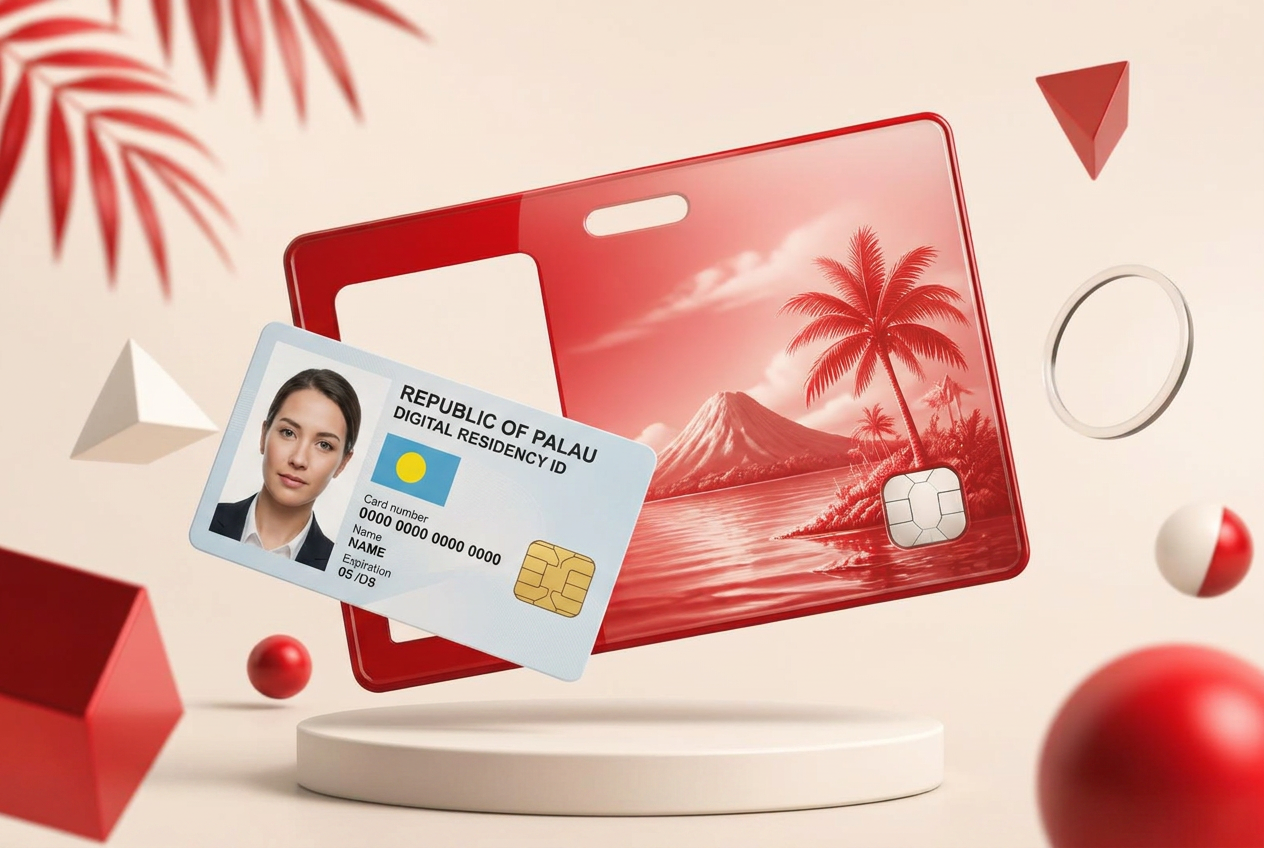
Palau's Root Name e-Residency programme is the newest and least understood entry in the digital-ID space, and it gets talked about online in ways that range from wildly overhyped to dismissively wrong. We've fielded enough client questions about it at Bizvee to know the confusion is real, so here's a straight breakdown: what Palau's e-Residency genuinely offers, who it fits, what it costs, and — because this matters more here than almost anywhere else — what it does not yet do.
What Palau e-Residency Actually Is
Palau, a small Pacific island nation of about 18,000 people, launched its "Root Name System" (RNS) digital ID in partnership with a private blockchain-identity company. It issues a government-backed digital identity credential to non-residents, built on blockchain-based verification rather than the smart-card model Estonia uses.
It is explicitly marketed around two use cases: acting as a verified digital ID for online and financial services, and offering a pathway toward a Palau-registered company structure for those who want one.
What it is not:
- Not citizenship. No passport, no nationality, no immigration status.
- Not physical residency. You don't gain any right to live in Palau.
- Not automatic tax residency, and critically, Palau does not have an extensive network of tax treaties or a mature domestic tax framework comparable to Estonia's — so don't expect a fully worked-out corporate tax regime with decades of case law behind it.
- Not yet broadly recognised by mainstream banks. This is the single biggest practical limitation, and we'll come back to it.
Palau's pitch is less "run your EU company remotely" and more "get a government-issued, KYC-grade digital identity that can plug into crypto and fintech platforms that require ID verification but don't need a full passport-and-utility-bill packet." That's a genuinely different value proposition from Estonia's, and it's worth being honest about that difference rather than pretending they're interchangeable.
Eligibility and Who Actually Benefits
Palau e-Residency is open to almost anyone globally, with fewer eligibility hurdles than Estonia's background-check-heavy process. In practice, the people who get real value out of it fall into a few camps:
Crypto-native individuals and traders who want a recognised, government-issued digital ID to satisfy KYC on exchanges and platforms without submitting their passport to every single provider, or who want an ID layer that plausibly works with certain crypto-friendly services that accept the credential.
Digital nomads exploring alternative structures who like the idea of a low-cost, low-friction identity credential as one layer of a broader multi-jurisdiction setup, rather than a single silver-bullet solution.
Early adopters and testers — people who are comfortable being early on infrastructure that's still maturing, understand they're taking a calculated bet on a young programme, and aren't relying on it for anything mission-critical yet.
Individuals wanting a company registration option outside major jurisdictions for specific privacy or diversification reasons, understanding that this comes with real banking limitations.
Who it doesn't suit: anyone who needs a bank-account-ready company on day one, anyone expecting EU-style legal infrastructure or dispute resolution maturity, and anyone who needs the credential to satisfy a specific regulator or institution — check first whether that institution actually accepts Palau ID before paying for it.
Step-by-Step: The Application Process
- Apply online through the official Root Name / Palau e-Residency portal. The process is fully digital — no embassy visit required for the ID itself, which is a meaningful difference from Estonia.
- Submit identity documents — passport scan and a selfie/liveness check, verified through the platform's identity verification partner.
- Pay the application fee. Pricing has varied as the programme has evolved; expect a fee in the low hundreds of dollars for the digital ID itself, with company formation priced separately and additionally.
- Verification and issuance. Because there's no in-person pickup requirement, turnaround is typically much faster than Estonia — often days rather than weeks, though processing times have fluctuated as the programme scales.
- Receive your digital ID credential, accessible via the associated app/wallet, which stores your verified identity attributes for use with participating services.
- Optionally register a Palau company as a separate, additional step, typically arranged through a registered agent, with its own fee schedule and documentation (director/shareholder details, business activity description, registered agent appointment).
Because no in-country office visit is required for the digital ID itself, there's no "pickup location" model like Estonia's embassy network — everything happens online, which is either a feature or a limitation depending on how much you value government-verified in-person issuance.
What the Digital ID Actually Lets You Do
- Identity verification for participating platforms — some crypto exchanges and fintech services accept the credential as a KYC layer, though acceptance is far from universal and changes over time, so verify current partner lists before assuming any specific platform accepts it.
- Digital signing for documents within the Palau ecosystem and for company formation paperwork.
- A pathway to Palau company registration for those who want an offshore-style entity, though this is a distinct product from the ID itself and priced separately.
- Not (currently) a reliable route to traditional bank accounts. This needs to be said plainly: mainstream banks generally do not yet recognise Palau e-Residency as a standalone KYC credential the way they might weigh a UK or Estonian company document.
Costs: A Realistic Table
| Item | Typical Cost | Notes |
|---|---|---|
| Digital ID application/state fee | Roughly $200–$260 | Pricing has changed over the programme's life; confirm current fee before applying |
| Palau company formation | Separate, agent-dependent — often $1,000+ | Not bundled automatically with the ID |
| Registered agent (mandatory for company) | Annual fee, typically several hundred dollars | Required to maintain the company's local presence |
| Accounting/compliance | Varies, often minimal formal requirement compared to Estonia | Still budget for basic bookkeeping if operating a real business |
| Renewal of digital ID | Periodic, fee-dependent on programme terms | Check current renewal terms; the programme is still young |
Because pricing structures here have shifted since launch, treat these as directional rather than fixed, and get a current quote before committing. This is one of the areas where working with an experienced formation partner like Bizvee is genuinely useful — we track which fees and requirements are current versus outdated marketing copy still floating around online.
Banking and Payments: The Reality Check
This is the section to read twice before applying. Palau e-Residency, as of now, does not come with a reliable path to a traditional business bank account. Mainstream banks — even ones generally open to offshore structures — typically want to see a jurisdiction with an established regulatory and AML framework they recognise, and Palau's e-Residency/company product is still building that track record.
Practical reality:
- Crypto exchanges are the most plausible place the Palau digital ID gets used for verification purposes, and even there, acceptance varies by platform and changes without much notice.
- EMIs like Wise or Payoneer generally underwrite based on the company's actual jurisdiction, ownership, and business activity — not the existence of an e-Residency credential — so a Palau company still goes through the same KYC scrutiny any offshore-adjacent entity would face, sometimes more.
- Expect friction. If your business model depends on frictionless payment processing from day one, Palau's current infrastructure is not the place to build that assumption.
We'd rather tell clients this upfront than let them find out after paying the fee.
Taxation, Explained Clearly
Palau does not offer a globally recognised, deeply codified corporate tax regime comparable to Estonia's 0%-on-retained-profits model. The country has its own domestic tax rules for locally-operating businesses, but the appeal of the e-Residency/company product for international users leans more toward simplicity and privacy than a proven, treaty-backed tax optimisation structure.
Key points:
- It is not automatic tax residency anywhere, and it doesn't exempt you from your home country's tax obligations on worldwide income.
- CFC rules in your home country may still treat a Palau company you control as a controlled foreign entity, taxing profits as if earned domestically, regardless of Palau's own tax treatment.
- VAT/GST considerations depend entirely on where your customers are — Palau's own regime doesn't remove your obligation to register for VAT in the EU, UK, or elsewhere if you cross relevant thresholds selling to those markets.
- Get bespoke advice. Because this jurisdiction's tax treaty network and international recognition are limited compared to Estonia or major LLC states, a tax advisor's individualised read is more important here than for more established programmes.
Compliance Calendar
| When | What's Due |
|---|---|
| At renewal (check current interval) | Digital ID renewal fee and re-verification |
| Ongoing, if company formed | Registered agent fee, maintained annually |
| As required by home country | Personal tax filings reflecting worldwide income/ownership |
| As required | Basic company records if operating a Palau entity |
Compared to Estonia, the formal compliance calendar is lighter — which appeals to some users and worries others, since "lighter compliance" can also mean "less institutional infrastructure to lean on if something goes wrong."
Pros and Cons
| Pros | Cons |
|---|---|
| Fully remote application, no embassy visit | Limited bank recognition currently |
| Fast issuance compared to Estonia | Young programme, less legal precedent |
| Useful as a KYC credential on some crypto platforms | Acceptance by third parties inconsistent and changing |
| Lower entry fee for the ID itself | Company formation and accounting add real additional cost |
| Appeals to privacy-minded, crypto-native users | Not a substitute for a bank-ready jurisdiction |
Palau vs Estonia vs Azerbaijan vs UK LTD vs US LLC
| Factor | Palau | Estonia (OÜ) | Azerbaijan | UK LTD | US LLC |
|---|---|---|---|---|---|
| Programme maturity | New, still evolving | Long-running (since 2014), mature | Newer, expanding | Centuries-old system | Long-established |
| Application method | Fully remote | Remote apply, in-person pickup required | In-person pickup required | Remote incorporation | Remote incorporation |
| Bank account access | Weak currently | Moderate (EMIs easier than banks) | Limited outside region | Strong | Strong |
| Best fit | Crypto-native individuals, early adopters | EU-facing SaaS/consulting/e-commerce | Regional trade-focused businesses | UK/EU-facing businesses | US-facing e-commerce/marketplaces |
| Corporate tax clarity | Limited, still developing | Well-documented 0% retained / ~20% distributed | Developing framework | Well-documented, 19–25% | Well-documented pass-through |
Who Should NOT Apply
- Anyone who needs a bank account guaranteed shortly after formation.
- Anyone assuming this gives tax residency or tax reduction without checking their home country's CFC and worldwide-income rules first.
- Businesses needing strong institutional credibility with enterprise clients or regulators today — Estonia or the UK will serve that need better right now.
- Anyone unwilling to accept the risk that a young programme's rules, fees, and partner acceptance lists can change.
Common Mistakes We See
- Assuming Palau e-Residency and Estonia e-Residency are interchangeable products. They solve different problems.
- Paying for company formation expecting instant bank access, then being surprised at the KYC friction.
- Not checking whether the specific platform they want to use actually accepts the Palau credential before paying the fee.
- Ignoring home-country CFC and personal tax rules, assuming a foreign digital ID changes tax exposure — it generally doesn't.
- Skipping professional guidance on a genuinely newer jurisdiction where terms and fees shift faster than in established programmes — this is exactly the kind of situation where a second, current-information opinion from a firm like Bizvee saves money before you commit, not after.
FAQ
Is Palau e-Residency the same as Estonia's? No. They're built on different technology (blockchain-based ID vs smart-card), have different maturity levels, and different real-world acceptance, especially in banking.
Do I need to visit Palau to get e-Residency? No — the application and issuance process is fully online, unlike Estonia's mandatory in-person pickup.
Can I open a bank account with Palau e-Residency alone? Not reliably. Traditional banks generally don't yet treat it as sufficient standalone KYC, and even EMIs will assess your company independently.
Does it grant tax residency in Palau? No, and Palau's tax treaty network is limited compared to major jurisdictions, so don't assume favourable tax treatment without dedicated advice.
Is it legitimate? Yes, it's a government-backed programme, but "legitimate" and "mature/widely recognised" are different things — treat it as an early-stage offering.
Who accepts the Palau digital ID for verification? A limited and changing set of crypto and fintech platforms; always confirm current acceptance before relying on it for a specific use case.
How much does it cost overall? Budget roughly $200–$260 for the ID itself, and significantly more (often $1,000+) if you also form a company and appoint a registered agent.
Can I use it alongside an Estonian or UK company? Yes — some users treat it as one identity layer within a broader, diversified structure rather than a sole solution.
Is company formation included in the e-Residency fee? No, it's a separate product with its own cost and registered-agent requirement.
Will my home country tax me despite having a Palau company? Almost certainly yes on your personal income, and potentially on the company itself under CFC rules — check with a tax advisor familiar with your home jurisdiction.
This article is for general informational purposes only and does not constitute tax, legal, or immigration advice — Palau's e-Residency programme is relatively new and terms change, so confirm current details before acting.
Ready to start your company?
Launch in the US, UK, Canada, or Australia with Bizvee — formation, banking support, bookkeeping and filings.