
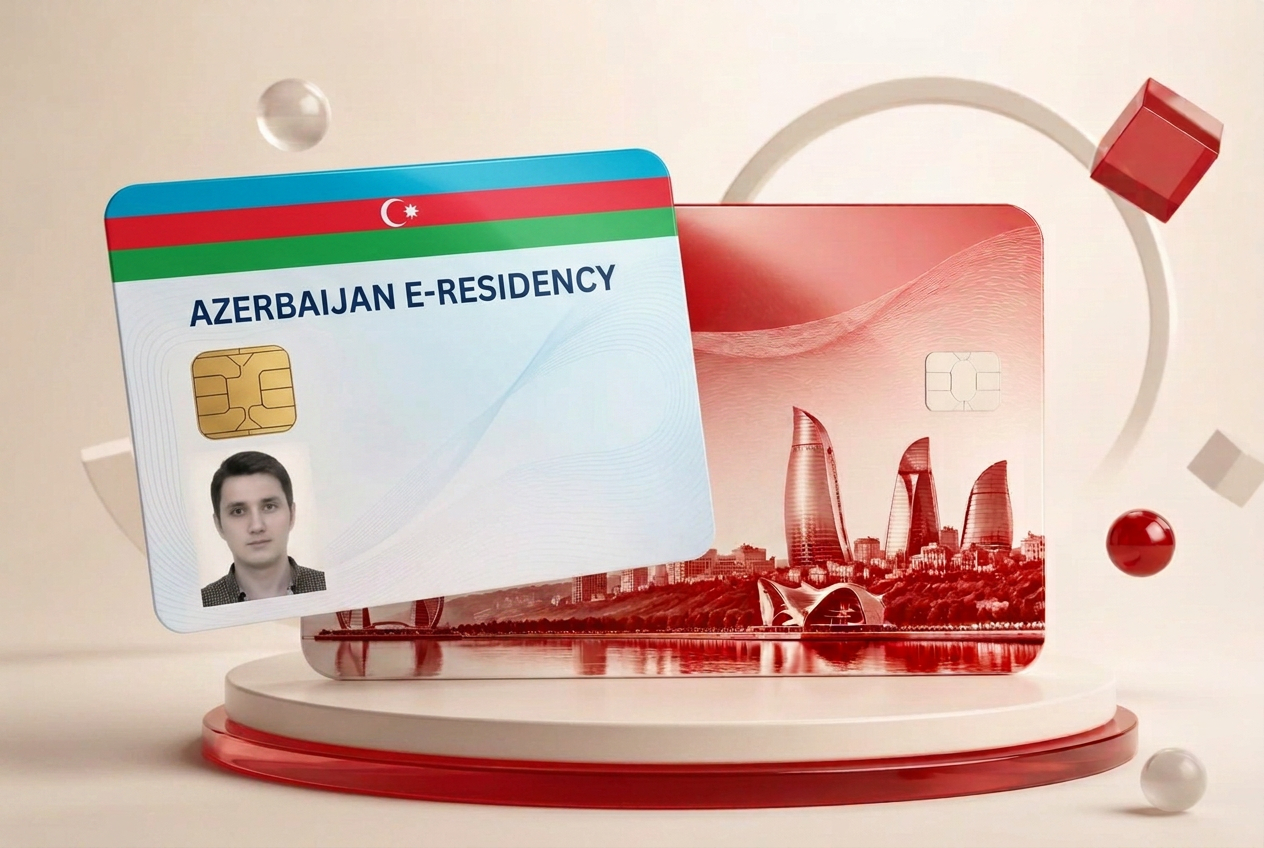
Azerbaijan's m-Residency (mobile residency) programme is the least talked-about digital-ID scheme in this comparison, and that's mostly because it's newer and more regionally focused than Estonia's e-Residency. But for businesses with actual trade or service ties to the Caucasus and CIS region, it's worth understanding properly rather than dismissing as "another copy of Estonia." At Bizvee we've had a growing number of questions from clients trading with Turkey, Georgia, Central Asia, and the wider region about whether m-Residency is worth pursuing — here's the honest picture.
What m-Residency Actually Is
Azerbaijan launched m-Residency as a digital identification and company-registration system modelled loosely on Estonia's approach but built around Azerbaijan's own e-government infrastructure (ASAN, the country's well-regarded digital public services platform). It issues a digital identity to non-citizens, enabling remote registration and management of an Azerbaijani company.
What it is not:
- Not citizenship. No passport, no nationality rights.
- Not physical residency. It grants no right to live in Azerbaijan and no immigration status.
- Not automatic tax residency. Azerbaijani tax residency is determined separately, generally based on physical presence (183+ days), and m-Residency doesn't substitute for that determination.
- Not a shortcut around Azerbaijan's actual corporate and tax law — you're still forming a real Azerbaijani legal entity, subject to real Azerbaijani rules, just with a more convenient digital layer for doing so remotely.
The clearest way to describe m-Residency: it's Azerbaijan's answer to "how do we let a freelancer in Istanbul, Tbilisi, or Dubai register and run a local company without flying in for every notarised document," built on the country's genuinely modern digital-government backbone.
Eligibility and Who Actually Benefits
m-Residency tends to make the most sense for:
Businesses trading with or servicing the Caucasus/CIS region — import-export operators, logistics coordinators, and consultants who need a local entity to invoice regional clients and manage regional VAT/customs paperwork credibly.
Freelancers and remote service providers based in neighbouring countries (Turkey, Georgia, Russia, Central Asian states) who want an Azerbaijani entity for tax or client-facing reasons specific to that trade corridor.
E-commerce sellers targeting the regional market, where having a local entity smooths payment processing, local marketplace registration, and customer trust.
Investors or founders setting up a regional holding presence ahead of broader Central Asia/Caucasus expansion, using Azerbaijan as an operational base with reasonably strong digital infrastructure.
Who it doesn't suit: founders with no genuine business connection to the region, anyone expecting EU-level banking access or global brand recognition from an Azerbaijani entity, and anyone hoping to use it purely as a tax-avoidance vehicle disconnected from real regional activity — that's a fast way to trigger both local scrutiny and home-country anti-avoidance rules.
Step-by-Step: The Application Process
- Apply through Azerbaijan's designated m-Residency portal / ASAN-linked service, submitting passport details, a photo, and a description of intended business activity.
- Identity verification, which may include a video call or additional document checks depending on your nationality and the nature of your intended business.
- Pay the applicable fee. Fees here are set by government schedule and have historically been positioned as competitively low relative to Estonia's; confirm the current published fee before applying, as figures are periodically updated.
- Background and compliance screening, broadly similar in purpose to Estonia's check, though processing timelines and required documentation can differ and are worth confirming directly with a registered agent or the official portal beforehand.
- Card/credential issuance and collection. Azerbaijan has used designated pickup points, including options within the country and through select consular services abroad — availability of overseas pickup locations has been narrower than Estonia's global embassy network, so check which pickup points are currently active for your location before applying.
- Activate the credential and use it to register a company through Azerbaijan's digital business registry, appoint yourself as director, and begin managing filings.
Expect the overall timeline to run several weeks from application to a usable credential, with company registration itself often completable within days once the credential is active — broadly comparable to Estonia's speed advantage once you're past the identity-verification stage.
What the Digital ID Actually Lets You Do
- Remote company registration in Azerbaijan, without needing to be physically present for every incorporation step.
- Digital signing of company documents and filings recognised under Azerbaijani law.
- Access to Azerbaijan's tax authority portal for filing corporate and VAT returns.
- Remote company management, including changes to directors, share structure, and registered details.
- A credible local entity for invoicing regional clients, registering with regional marketplaces, and demonstrating a genuine business presence in the Caucasus for partners who value that.
Costs: A Realistic Table
| Item | Typical Cost | Notes |
|---|---|---|
| m-Residency application/state fee | Modest, government-set (confirm current figure) | Historically positioned as low-cost relative to Estonia |
| Company formation | Government fee plus agent assistance, often a few hundred USD total | Varies by entity type (LLC-equivalent is most common for foreign founders) |
| Registered address/local agent | Often required if no local director | Annual fee, agent-dependent |
| Accounting/compliance | Ongoing monthly or quarterly fee | Scales with transaction volume and VAT registration status |
| Annual filings | Modest government fee plus preparation cost | Timing tied to Azerbaijani fiscal filing calendar |
Because published fee schedules here move with government policy updates more often than Estonia's, this is another area where getting a current quote from a formation agent — Bizvee handles this alongside our Estonia and broader company-formation work — saves you from budgeting off outdated numbers found in older blog posts.
Banking and Payments: The Reality Check
Banking is the area where expectations need the most calibration. Azerbaijani banks are used to onboarding local businesses and increasingly used to regional trade finance, but they are not yet a plug-and-play option for founders with no regional ties, and international brand-name EMIs treat an Azerbaijani entity roughly the way they'd treat any entity from a jurisdiction they're less familiar with — extra scrutiny, more documentation requests, longer approval timelines.
Practical patterns:
- Local Azerbaijani banks are generally the most realistic option for day-to-day operational banking if your business genuinely operates in-region, but expect in-person elements or at least a strong documentation trail even for m-Residents.
- Wise, Payoneer, and similar EMIs can sometimes onboard Azerbaijani companies, but approval isn't guaranteed and often depends heavily on your personal nationality, source of funds, and the clarity of your business model — treat this as case-by-case, not a default assumption.
- Regional payment processors and marketplaces tied to Turkey, Russia, or Central Asia may actually be easier to integrate with than Western-brand EMIs, which is one of the genuine advantages of having a local entity if that's your target market.
Taxation, Explained Clearly
Azerbaijan's standard corporate income tax rate sits around 20% for most companies, with certain simplified tax regimes and reduced rates available for smaller businesses or specific sectors — figures and thresholds are set by domestic tax law and are periodically revised, so confirm the current rate and any applicable simplified regime with a local accountant before modelling numbers.
Key clarifications:
- m-Residency does not create Azerbaijani personal tax residency. That's determined separately, generally through the 183-day physical presence test.
- VAT applies to most goods and services at Azerbaijan's standard rate, with registration thresholds and rules that a local accountant should confirm against your actual turnover and activity type.
- Home-country tax exposure remains — profits distributed to you personally are very likely taxable in your actual country of tax residence, and CFC rules in stricter jurisdictions may look through the Azerbaijani entity entirely if it's substance-light.
- This is not a zero-tax jurisdiction the way Estonia's retained-profit treatment is often marketed — Azerbaijan's regime is a standard corporate tax system with its own compliance calendar, not a deferral mechanism.
Compliance Calendar
| When | What's Due |
|---|---|
| Monthly/Quarterly (activity-dependent) | VAT filings if registered |
| Ongoing | Bookkeeping and invoice records |
| Annually | Corporate tax return and annual company filings |
| As needed | Updates to director/shareholder registry when changes occur |
| Ongoing | Maintain registered address/local agent if required |
Pros and Cons
| Pros | Cons |
|---|---|
| Strong digital-government backbone (ASAN) behind it | Less globally recognised than Estonia's programme |
| Genuinely useful for Caucasus/CIS-facing trade | Banking access outside the region is inconsistent |
| Comparatively low state fees | Overseas pickup locations more limited than Estonia's |
| Fast company registration once credential is active | Less mature legal/dispute-resolution track record internationally |
| Access to regional payment rails and marketplaces | Not a meaningful fit without genuine regional business ties |
Azerbaijan vs Estonia vs Palau vs UK LTD vs US LLC
| Factor | Azerbaijan (m-Residency) | Estonia (OÜ) | Palau | UK LTD | US LLC |
|---|---|---|---|---|---|
| Best regional fit | Caucasus, CIS, Turkey trade corridor | EU/global SaaS and consulting | Crypto-native, early adopters globally | UK/EU clients | US clients, marketplaces |
| Corporate tax | ~20% standard rate (confirm current) | 0% retained / ~20% distributed | Limited formal framework | 19–25% | Pass-through, no federal entity tax |
| Banking outside home region | Inconsistent | Moderate (EMIs easier than banks) | Weak currently | Strong | Strong |
| Programme maturity | Newer, growing | Mature, long-running | Newest, still evolving | Long-established | Long-established |
| Pickup requirement | Yes, limited overseas points | Yes, wide embassy network | No physical pickup | No digital-ID step | No digital-ID step |
Who Should NOT Apply
- Founders with no actual business reason to operate in or trade with the Caucasus/CIS region.
- Anyone expecting Western-bank-grade account access from day one.
- Businesses hoping to use the entity purely as a tax shelter without real local substance — this invites both local and home-country scrutiny.
- Anyone unwilling to work with a local accountant familiar with Azerbaijani filing deadlines, which differ meaningfully from Estonia's or the UK's.
Common Mistakes We See
- Treating m-Residency as an Estonia clone and assuming identical tax and banking outcomes — the regimes and banking realities differ substantially.
- Underestimating regional-only banking access and being surprised when a Western EMI declines the account.
- Skipping local tax advice, assuming the ~20% corporate rate works the same way as Estonia's retained-profit model — it doesn't; Azerbaijan taxes profit more conventionally.
- Forming the entity without a genuine regional business case, then struggling to justify substance if questioned by either country's tax authority.
- Not confirming current pickup locations before applying, since overseas collection points are more limited than Estonia's — this is exactly the kind of regionally specific detail Bizvee checks with clients before they commit to a filing date.
FAQ
Is m-Residency the same as e-Residency? Conceptually similar — a digital ID enabling remote company management — but built on different infrastructure, with different banking realities and a narrower international pickup network.
Do I need to visit Azerbaijan to get m-Residency? Not necessarily for the application itself, but credential collection typically requires a designated pickup point, which may be more limited overseas than Estonia's embassy network — confirm current options for your location.
Does m-Residency grant Azerbaijani tax residency? No. Personal tax residency is determined separately, generally through physical presence rules.
What's the corporate tax rate? Standard rate is around 20% for most companies, with some reduced or simplified regimes available depending on business type and size — confirm current rules with a local accountant.
Can I open a bank account remotely? Sometimes through regional banks or select EMIs, but approval is case-by-case and less predictable than with Estonia's or the UK's banking ecosystem.
Who benefits most from this programme? Businesses with genuine trade or service ties to Azerbaijan, Turkey, Georgia, Central Asia, or the wider CIS region.
Is this a good fit for a pure SaaS business with EU/US clients only? Usually not the best fit — Estonia or a UK/US entity will typically serve that audience better.
How does VAT work? Azerbaijan has its own VAT system with standard rates and registration thresholds separate from EU VAT rules — don't assume EU OSS rules apply.
Will my home country still tax profits I withdraw? Yes, almost certainly, and CFC rules may apply if the entity lacks real local substance.
Is the application fee similar to Estonia's? Historically positioned as comparably low or lower, but figures change with government policy — confirm the current published fee before applying.
This article is for general informational purposes only and does not constitute tax, legal, or immigration advice — Azerbaijan's m-Residency terms, fees, and pickup locations are updated periodically, so confirm current details before acting.
Ready to start your company?
Launch in the US, UK, Canada, or Australia with Bizvee — formation, banking support, bookkeeping and filings.